Regulating Trade in Services in the EU and the WTO: Trust, Distrust and Economic Integration by Ioannis Lianos & Okeoghene Odudu
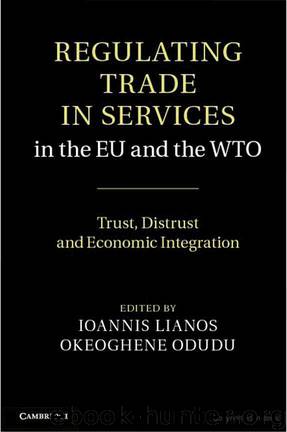
Author:Ioannis Lianos & Okeoghene Odudu
Language: eng
Format: mobi
Tags: Foreign & International Law, Specialties, Law, Education & Reference, Military
ISBN: 9781107008649
Publisher: Cambridge University Press
Published: 2012-04-22T18:30:00+00:00
Cambridge Books Online
http://ebooks.cambridge.org/
Regulating Trade in Services in the EU and the WTO
Trust, Distrust and Economic Integration
Edited by Ioannis Lianos, Okeoghene Odudu
Book DOI: http://dx.doi.org/10.1017/CBO9781139022118
Online ISBN: 9781139022118
Hardback ISBN: 9781107008649
Chapter
7 - Trusting the Poles? Mark 2 pp. 263-298
Chapter DOI: http://dx.doi.org/10.1017/CBO9781139022118.011
Cambridge University Press
7
Trusting the Poles? Mark 2: towards a regulatory
peace theory in a world of mutual recognition
k a l y p s o n i c o l a Ï dis*
1.
Introduction
There are all kinds of regulatory wars out there. Some wars pit ‘regulatory
cultures’ against one another; others pit free traders against consumer
protectors and all the variants of liberal, statist, technocratic or paternalistic
approaches; others still confront low against high standards systems – in
their race to the bottom (or the top) anything goes. And, in Europe of
course, wars may pit Polish plumbers against local (imaginary) compet-
itors. True, regulatory wars (or competition) may serve as useful
selection mechanisms. But, as the 2008–11 financial crisis has amply
demonstrated, there is little doubt that at least some lulls of regulatory
peace would serve the greater good.
By ‘regulatory peace’ I mean a stable state of cooperation among
regulators from different jurisdictions (usually countries), where ‘reg-
ulators’ stand for standards-setters in general, from legislators to agen-
cies, standards organizations or accreditors. ‘A stable state of
cooperation’ needs to be defined, as this does not of course mean
harmony, but rather the existence of mechanisms to manage the
unavoidable mix of convergent and divergent interests between these
actors, mechanisms which allow them to pursue the public good in their
own jurisdiction while minimizing negative externalities for outsiders,
that is refraining from engaging in regulatory behaviour aimed at
* This chapter was first presented in Cambridge at the Modern Law Review conference,
1 July 2009. I thank the participants for greatly stimulating discussions and Ioannis
Lianos for his further input. The paper includes and builds on an earlier publication,
‘Trusting the Poles? Constructing Europe through Mutual Recognition’, Journal of
European Public Policy 15 (5) (2007) 682–98.
263
Downloaded from Cambridge Books Online by IP 14.139.43.12 on Mon Oct 08 04:37:17 BST 2012.
http://dx.doi.org/10.1017/CBO9781139022118.011
Cambridge Books Online © Cambridge University Press, 2012
264
k a l y p s o n i c o l a Ï d i s
undermining the other side. For the purpose of this enquiry, the exter-
nalities in question stem from the movement of goods and services
across borders. In a loose analogy to what is referred to in international
relations (IR) as ‘democratic peace theory’ (DPT), we need to ask what
are the factors that make regulatory peace more likely both as character-
istics of individual jurisdictions and as attributes of the interactions
between them. This is obviously a very ambitious endeavour, which
would need to draw on the many strands of the burgeoning literature on
domestic and transnational regulation as it relates to the free movement
of goods and services across borders.1
Clearly, a ‘regulatory peace theory’ (RPT), if we choose to call it that,
could only claim a loose analogy to its broader macro-political fore-
bearer, DPT, as discussed briefly in the later part of this chapter.
Nevertheless, I hope that this might prove a fruitful way to revisit some
earlier analysis on the trade/regulation nexus.2 I have argued in the past
that a
Download
This site does not store any files on its server. We only index and link to content provided by other sites. Please contact the content providers to delete copyright contents if any and email us, we'll remove relevant links or contents immediately.
The Thirst by Nesbo Jo(6944)
Permanent Record by Edward Snowden(5847)
The Myth of the Strong Leader by Archie Brown(5508)
Spare by Prince Harry The Duke of Sussex(5197)
A Higher Loyalty: Truth, Lies, and Leadership by James Comey(4964)
Secrecy World by Jake Bernstein(4753)
Adulting by Kelly Williams Brown(4574)
The Borden Murders by Sarah Miller(4325)
Machine Learning at Scale with H2O by Gregory Keys | David Whiting(4313)
Killers of the Flower Moon by David Grann(4055)
American Kingpin by Nick Bilton(3887)
The Secret Barrister by The Secret Barrister(3710)
Fear by Bob Woodward(3697)
Future Crimes by Marc Goodman(3600)
The Last Girl by Nadia Murad(3509)
The House on Mango Street by Sandra Cisneros(3472)
Liar's Poker by Michael Lewis(3450)
Oathbringer (The Stormlight Archive, Book 3) by Brandon Sanderson(3216)
The Social Psychology of Inequality by Unknown(3031)
